The accordion breathes
The Book Thief“The accordion breathes” is a recurring expression that makes Hans Hubermann’s instrument more than a musical object: its physical motion becomes a sign of life, and its sound becomes a vessel for Liesel Meminger’s attachment to Papa. Across domestic music-making, literacy, memory, and bereavement, the phrase links breath with care and turns the accordion into an audible form of human continuity.
The Instrument Made Alive
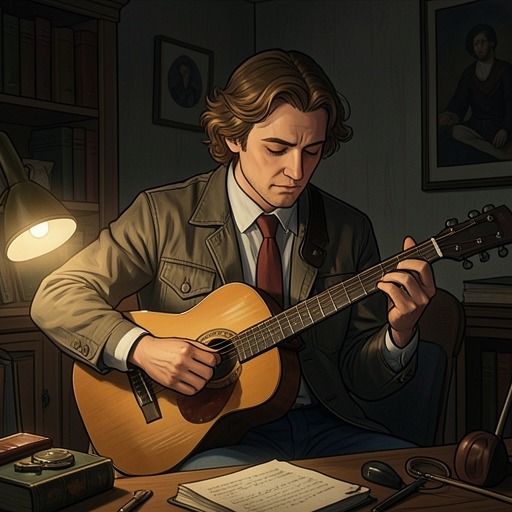
Hans’s accordion is described through the mechanics of its movement. His right hand travels across the tooth-colored keys while his left hand works the buttons, including the silver, sparkled C-major button that Liesel especially loves to watch. The scratched but shiny black casing moves back and forth as his arms squeeze the dusty bellows, making the instrument draw in air and cast it out again. The passage presents music as a bodily process: the accordion appears to inhale and exhale, so its sound seems to arise from a living creature rather than from an inert machine.
That effect is intensified by the domestic setting. Hans plays while his bread and jam sit half eaten on the kitchen plate, and the music seems to look directly at Liesel. Sometimes, deliberately provoking Rosa Hubermann, he brings the instrument into the kitchen and plays through breakfast. His awkward wink and Liesel’s clumsy answering wink make the performance an exchange between them, while the music gives their affection a form that does not require explanation. The accordion’s breath is therefore also Hans’s emotional presence: gentle, humorous, and intimate within the household.
Breath, Language, and Learning
The expression acquires a second life in Liesel’s development as a reader and writer. During a lesson in which Hans writes a word and completes it with one of his sketches, Liesel’s response is startled and embarrassed, while Hans’s laughter quickly gives way to a warning that they must remain quiet. The scene joins the accordion’s expressive warmth to the difficult, playful work through which Hans teaches Liesel language. His music and his writing lessons are parallel forms of communication: one passes through keys and bellows, the other through words, drawings, and shared attention.
When Liesel later records her life, she writes that the accordion breathes. She is in the basement with Hans, who has brought the instrument down and sits close to the place where Max Vandenburg used to sit. He plays for half an hour while she writes, and she studies his fingers and face. The written phrase is not an abstract description of music; it preserves a particular scene in which Hans’s playing, Liesel’s authorship, and Max’s absence occupy the same space. The accordion’s breathing becomes a bridge between the living figures present and the person whose former place remains visible through memory.
Memory After Loss
The phrase becomes most powerful after Hans’s death. Liesel asks for Papa’s accordion, and an older member brings her the eaten case. She removes the injured instrument and places it beside Hans’s body, addressing him through the object: “Here, Papa.” The gesture restores the relationship at the moment when the body can no longer answer. The accordion is damaged, but it remains recognizable as the object through which Hans offered music, companionship, and a sense of shelter.
The narrative then moves beyond ordinary remembrance into a later vision seen by Liesel. She imagines Hans standing among broken houses, strapping on the accordion and playing for her one last time. The scene retains distinctive details of his familiar presence: kindness in his eyes, a cigarette slouched on his lips, and even a mistake that makes him laugh. The bellows breathe while the tall man plays, allowing the instrument to recreate not merely Hans’s music but his manner—the fallibility, humor, and tenderness that made him Papa.
Symbolic Significance
The expression works through a sustained metaphor in which breath marks life. The accordion requires air, but the narrative makes that mechanical action emotionally legible: when the bellows move, Hans’s care seems to continue moving through the household and through Liesel’s memory. The instrument consequently stands between object and person. It is not literally alive, yet its breathing gives physical shape to the persistence of a relationship after death.
Its meaning also depends on contrast. The accordion’s breath opposes the silence imposed by fear, the stillness of Hans’s corpse, and the destruction surrounding the final vision. In the basement, its music accompanies Liesel as she writes; beside the body, its injured form becomes a remnant; in the vision, its breathing briefly reopens the possibility of presence before Hans stops. The final command, “Keep playing, Papa,” and the immediate fact that Papa stops make the phrase both consoling and tragic. The accordion can preserve memory, but it cannot reverse death.
For Liesel, however, the instrument’s breathing remains part of the act of testimony. She writes while Hans plays, and she later carries the image into the story she tells. The phrase therefore joins music and authorship: Hans gives breath to the accordion, while Liesel gives renewed form to Hans through words. What survives is not an illusion that loss has been undone, but a record of how kindness once sounded and how memory continues to breathe after the player is gone.